Breaking Universality
in Dimer Models
Leonid Petrov
University of Virginia
Joint work with
Alisa Knizel (Barnard / Columbia)
arXiv:2507.22011 (opens in new tab)
and Alexey Bufetov, Panagiotis Zografos (Leipzig)
arXiv:2507.08560 (opens in new tab)
lpetrov.cc/lozenge-draw/
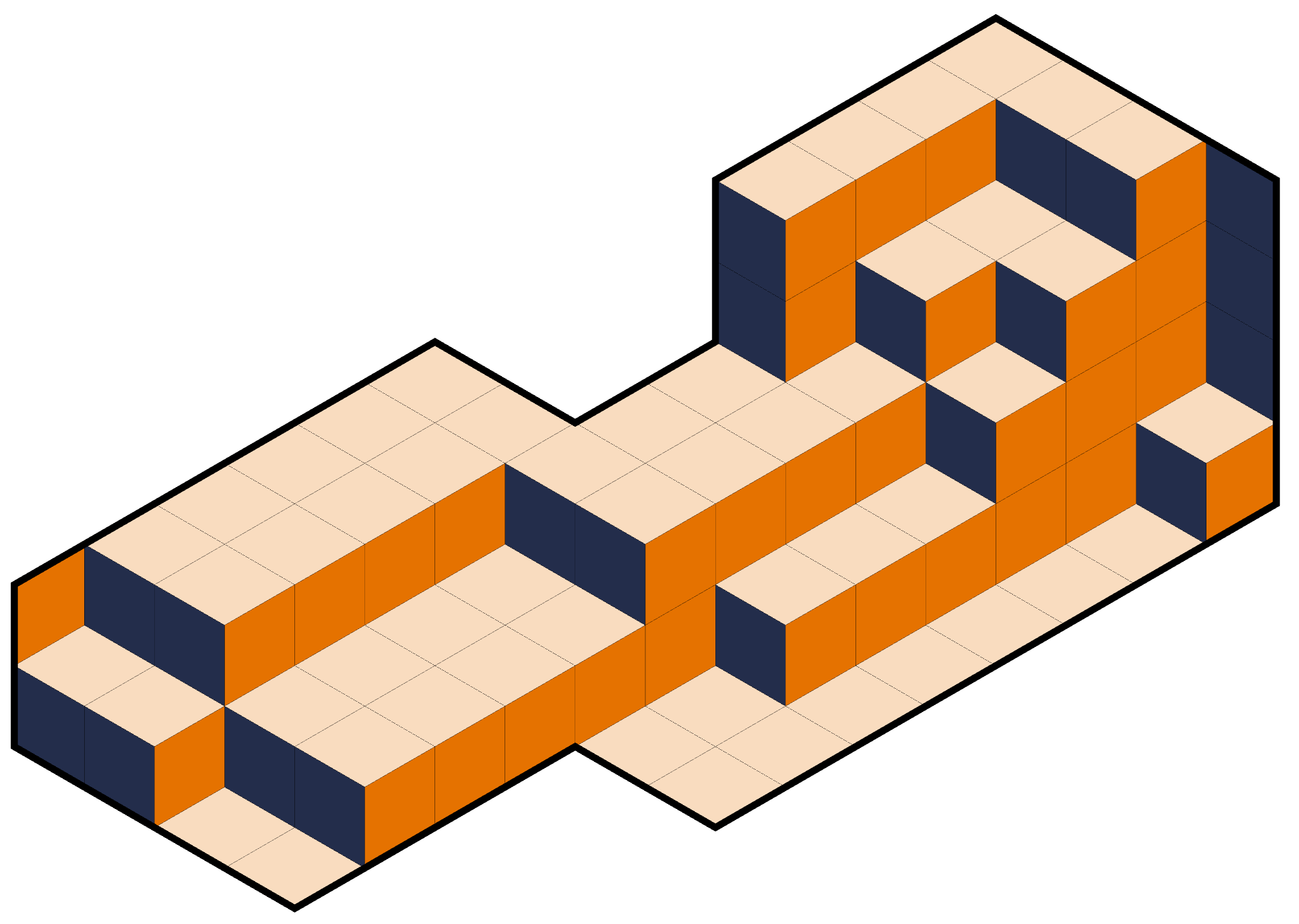
Draw a shape and tile by lozenges
Loading...
Part I
Brief Survey of Universality in Dimer Models
Random Discrete Surfaces
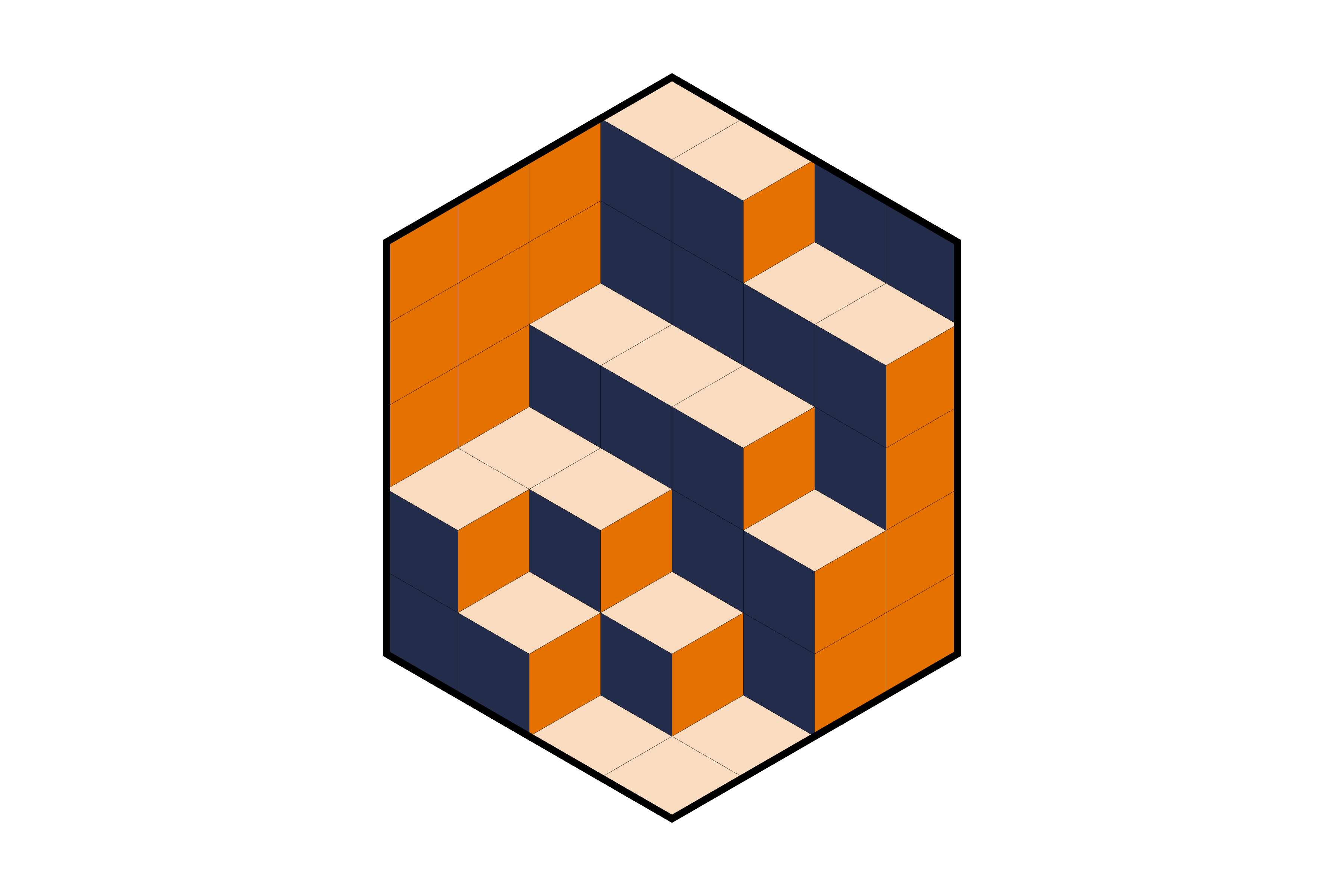
surface in 4 × 12 × 9 box
Theorem [MacMahon, c. 1900]:
Number of surfaces in \(a \times b \times c\) box is \(\displaystyle\prod_{i=1}^{a}\prod_{j=1}^{b}\prod_{k=1}^{c}\frac{i+j+k-1}{i+j+k-2}\)
For 9 × 12 × 9: 1,340,992,301,315,806,672,824,460,528,012,500
... and we pick one at random from this collection
How does a typical random surface look like, depending on the boundary?
Other Ways to Build 3D Surfaces
4 non-flat building blocks instead of 3 flat squares.
General theory for planar bipartite dimer models: [Kenyon–Okounkov–Sheffield 2006]
Glue into a surface.
The top-down view is a domino tiling of the Aztec diamond.
We will discuss domino tilings with random edge weights
Limit Shape in 3D
pre-sampled
Theorem [Cohn–Kenyon–Propp 2000]:
As the mesh size → 0, the random stepped surface concentrates around a deterministic limit shape. It develops flat and curved parts.
3D surfaces projected to \(x+y+z=0\) are lozenge tilings
with three types of lozenges.
Local Patches
Local patches:
- Approximate the surface by piecewise-planar patches
- Each patch is a flat random surface with a given slope \((s_1, s_2)\)
- For a given slope, the number of approximating 3D surfaces is \(\approx e^{N^2\cdot \sigma(s_1,s_2) }\)
Variational principle [Cohn–Kenyon–Propp 2000]:
Limit shape \(z=h(x,y)\) maximizes \[\displaystyle\iint \sigma(\nabla h)\, dxdy\] subject to boundary conditions on \(h(x,y)\)
\(\sigma(s_1,s_2) = \tfrac{1}{\pi}\bigl[\Lambda(\pi s_1) + \Lambda(\pi s_2) + \Lambda(\pi (1\!-\!s_1\!-\!s_2))\bigr]\)
\(\Lambda(\theta)=-\!\int_0^\theta \ln|2\sin t|\,dt\) (Lobachevsky function)
Other 3D building blocks besides squares of three directions: [Kenyon–Okounkov–Sheffield 2006]
plane z=Ax+By
Universality: Zoom In
Zoom in around any point in the liquid region → same class of universal local statistics determined only by slope
(ergodic translationally invariant Gibbs measures on tilings of the full plane - pure states)
Determinantal point process in 2D:
\[\rho_k\bigl((t_1,x_1),\ldots,(t_k,x_k)\bigr) = \det\bigl[K(t_i,x_i; t_j,x_j)\bigr]_{i,j=1}^{k}\]
= probability to find non-blue lozenges at each \((t_i, x_i)\)
Incomplete Beta kernel:
\[K_u(t,x;s,y) = -\frac{1}{2\pi\mathbf{i}} \int_{\bar{u}}^{u} (1-z)^{t-s} z^{-(x-y)-1} dz\]
[Okounkov–Reshetikhin '01], [Sheffield '03], [Kenyon–Okounkov–Sheffield '03],
[Gorin '07], [P. '12], [Gorin–P. '16], [Aggarwal '19]
pre-sampled
Local structure at different slopes in the liquid region
Height Fluctuations
Gaussian Free Field
Like the Brownian bridge, but with two-dimensional time
\(\displaystyle \text{GFF} \approx \frac{h_1 - h_2}{\sqrt{2}}\)
where \(h_1, h_2\) are two independent samples of the height function.
Covariance structure:
The complex coordinate \(u\colon\) liquid region \(\to\) upper half plane \(\mathbb{H}\) determines the correlations:
\(\displaystyle \operatorname{Cov}(h(x_1), h(x_2)) \to -\frac{1}{2\pi^2} \ln\left|\frac{u(x_1)-u(x_2)}{u(x_1)-\bar u(x_2)}\right|\)
= Green function on \(\mathbb{H}\), pulled back by \(u\)
Fluctuations of the height function are \(O(\sqrt{\log N})\). Correlations stay bounded as \(N \to \infty\).
Universality is open even for simply connected domains.
[Kenyon 2001], [Kenyon 2008],
[Petrov 2014], [Berestycki–Laslier–Ray 2020],
[Bufetov–Gorin 2018], [Borot–Gorin–Guionnet 2026]
Universality: Domino Tilings
Same GFF for domino tilings
Height fluctuations of random domino tilings of the Aztec diamond converge to the Gaussian Free Field — same universality class as lozenge tilings
Covariance:
pulled back by conformal map \(u\) to \(\mathbb{H}\), same Green function structure
[Kenyon 2001], [Bufetov–Knizel 2018],
[Chelkak–Laslier–Russkikh 2020],
[Berggren–Nicoletti–Russkikh 2024]
Summary So Far
Limit shapes.
Random 3D surfaces have deterministic limit shapes as the mesh size \(\to 0\).
Local universality.
At the lattice level, local statistics display universal behavior (translation-invariant Gibbs measures determined by slope).
Global universality.
Globally, height fluctuations are described by the Gaussian Free Field.
Edge behavior / KPZ.
At the boundary between frozen and liquid regions, fluctuations are governed by the
Airy line ensemble — the same universal object appearing throughout the
\((1+1)\)-dimensional KPZ universality class
(TASEP, last-passage percolation, directed polymers, \(\ldots\)).
Not covered in this talk — but central to many other talks at this conference.
Part II
The Waterfall
Breaking Local Universality in Lozenge Tilings
with Alisa Knizel arXiv:2507.22011 (opens in new tab)
Q-volume deformation
q =
q =
q =
q =
q =
\(\displaystyle \text{Prob}(\text{surface}) = \frac{q^{\text{volume under surface}}}{\sum_{\text{all surfaces}} q^{\text{volume}}}\)
Variational principle (\(q = e^{-\gamma/N}\))
Maximize \(\displaystyle \iint \sigma(\nabla h) \, dx\,dy - \gamma \iint h \, dx\,dy\)
\(\gamma>0\): less volume · \(\gamma<0\): more volume
On the hexagon: related to q-Hahn orthogonal polynomials. Not the most general basic hypergeometric family...
For \(q = e^{-\gamma/N} \to 1\): expect the same universal local behavior (pure states with incomplete Beta kernel locally, and GFF fluctuations globally) — but less is proven
More deformation: q-Racah tilings of the hexagon
Orthogonal polynomials:
Classical: Hermite, Laguerre, Jacobi, Legendre, ...
→ if you ask for explicit coefficients, you can climb up to q-discrete ("exotic") world. The ladder is the (q-)Askey scheme
→ At the very top: q-Racah polynomials
→ if you ask for explicit coefficients, you can climb up to q-discrete ("exotic") world. The ladder is the (q-)Askey scheme
→ At the very top: q-Racah polynomials
Exactly solvable measure on boxed surfaces (hexagon tilings)
discovered by
[Borodin-Gorin-Rains 2009],
connected to the q-Racah polynomials
\[
\mathbb{P}(\text{tiling}) = \frac{1}{Z} \prod_{\substack{\text{horiz.}\\\text{lozenges}}} \mathrm{w}(h),\qquad \mathrm{w}(h) = \chi\, q^{h} + \frac{1}{\chi\, q^{h}}
\]
\(h\) — height, centered around the middle of the hexagon
\(q \in (0,1]\) — volume tilt, \(\chi > 0\) — interpolation parameter
\(\chi \to 0\) gives \(q^{-\text{vol}}\), \(\chi \to +\infty\) gives \(q^{+\text{vol}}\)
\(q \in (0,1]\) — volume tilt, \(\chi > 0\) — interpolation parameter
\(\chi \to 0\) gives \(q^{-\text{vol}}\), \(\chi \to +\infty\) gives \(q^{+\text{vol}}\)
Results [BGR 2009], [Dimitrov-Knizel 2019], [Gorin-Huang 2022], [Duits-Duse-Liu 2023]:
Same local limits (pure states) and GFF fluctuations as \(q = e^{-\gamma/N}\), but different limit shape
Example. Counting horizontal lozenges by centered height:
Particles in two dimensions in a double-well potential
| \(h = -2.5\): | 3 |
| \(h = -1.5\): | 2 |
| \(h = -0.5\): | 4 |
| \(h = \phantom{-}0.5\): | 3 |
| \(h = \phantom{-}1.5\): | 2 |
| \(h = \phantom{-}2.5\): | 2 |
q-Racah Tilings of Large Hexagons
\(q = 0.95\), \(\chi = 3\)
\(q = 0.8\), \(\chi = 3\)
When \(q = e^{-\gamma/N} \to 1\): curved limit shape
and the same universal local fluctuations
(pure states with the incomplete Beta kernel) as for the
uniform and q-volume measures
[Borodin-Gorin-Rains 2009].
Global fluctuations:
[Dimitrov-Knizel 2019], [Gorin-Huang 2022], [Duits-Duse-Liu 2023]
Global fluctuations:
[Dimitrov-Knizel 2019], [Gorin-Huang 2022], [Duits-Duse-Liu 2023]
But since 2009, it was not clear what happens for fixed \(q\).
This became known as the waterfall phenomenon.
The Waterfall: Dimensional Collapse [Knizel-P. 2025]
Theorem [Knizel-P. 2025, arXiv:2507.22011]
Probability to find a horizontal (light-colored) lozenge in the waterfall region is exponentially small:
\(\mathbb{P}(\text{horizontal lozenge}) \sim e^{-cN}\)
Why? \(\displaystyle\mathrm{w}(h) = \chi\, q^{h} + \frac{1}{\chi\, q^{h}}\) \(\to\) avoid center
Classical regime \(q = e^{-\gamma/N} \to 1\):
- frozen/semifrozen (no randomness but regular pattern of one or two colors)
- or liquid/gaseous (all three colors present; phases differ by correlation decay)
q-Racah Orthogonal Polynomial Ensemble
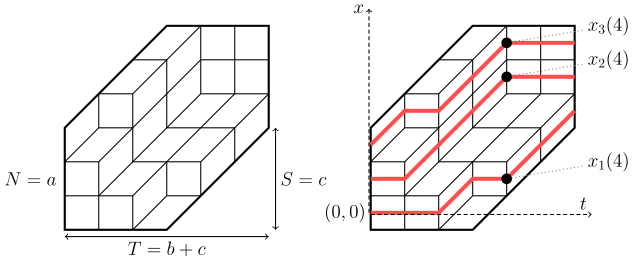
Vertical slice \(\to\) \(N\) noncolliding paths
Correlation kernel:
\(\displaystyle K_t(x, y) = \sum_{n=0}^{N-1} f_n^t(x) f_n^t(y)\)
\(f_n^t\): orthonormal q-Racah polynomials on slice \(t\)
\(K_t\): spectral projection for q-difference operator
Key observation [Borodin-Gorin-Rains 2009]
The marginal distribution of paths on a vertical slice is the q-Racah orthogonal polynomial ensemble.
This is basically how the deformation was discovered.
Joint distribution:
\(\displaystyle \mathfrak{R}^{qR(N)}_{M,\alpha,\beta,\gamma,\delta}(x_1, \ldots, x_N) = \frac{1}{Z} \prod_{1 \le i < j \le N} (\mu(x_i) - \mu(x_j))^2 \prod_{i=1}^N w^{qR}(x_i)\)
where \(\mu(x) = q^{-x} + \gamma\delta q^{x+1}\)
Weight function:
\(\displaystyle w^{qR}(x) := \frac{(\alpha q; q)_x (\beta\delta q; q)_x (\gamma q; q)_x (\gamma\delta q; q)_x}{(q; q)_x (\alpha^{-1}\gamma\delta q; q)_x (\beta^{-1}\gamma q; q)_x (\delta q; q)_x} \cdot \frac{(1 - \gamma\delta q^{2x+1})}{(\alpha\beta q)^x (1 - \gamma\delta q)}\)
\(\displaystyle (a; q)_k := (1-a)(1-aq) \cdots (1-aq^{k-1})\) is the q-Pochhammer symbol
Parameters:
\((M; \alpha, \beta, \gamma, \delta; q, \chi)\), \(\gamma = q^{-M-1}\)
\(\displaystyle M = t + N - 1,\ \alpha = q^{-S-N},\ \beta = q^{S-T-N},\ \gamma = q^{-t-N},\ \delta = -\chi^2 q^{-S+N}\)
Correlations:
\(\displaystyle \mathbb{P}(\text{particles at } p_1, \ldots, p_m) = \det\bigl[K_t(p_i, p_j)\bigr]_{i,j=1}^{m}\)
Local Limit for Fixed q
q-Difference operator: \(B(x), D(x)\) are explicit rational expressions in factors like \((q^T + \chi^2 q^{x+1})\),
\(\displaystyle (\mathfrak{D}^{qR}g)(x) := \sqrt{\frac{w^{qR}(x)}{w^{qR}(x+1)}}B(x)\,g(x+1) - [B(x)+D(x)]\,g(x) + \sqrt{\frac{w^{qR}(x)}{w^{qR}(x-1)}}D(x)\,g(x-1)\)
Correlation kernel:
\(\displaystyle K_t(x, y) = \sum_{n=0}^{N-1} f_n^t(x) f_n^t(y)\)
\(f_n^t\): orthonormal q-Racah polynomials on slice \(t\)
Kernel = projection onto spectral interval:
\(\displaystyle \bigl[-q^{-N+1}(1-q^{N-1})(q^{-T-N}-1),\, 0\bigr]\)
- [Reed-Simon 1972] Then spectral projections (kernels) converge!
- [Olshanski 2008] spectral projections for determinantal processes, [Tao 2011] nonrigorous application to random matrices
- [BGR 2009] extension to 2D correlations - not much difference with 1D when \(q=e^{-\gamma/N}\to 1\)
As \(T,S,N,x,t \to \infty\) proportionally while \(q = e^{-\gamma/N} \to 1\):
Coefficients behave nicely. Difference operators converge to
\(\displaystyle f \mapsto \tfrac{1}{2}(f(x+1) + f(x-1)) - c\,f(x)\)
Limiting spectral projection (onto \(\geq 0\)) is multiplication by \(\mathbf{1}_{\mathrm{Re}(z) > c}\)
Inverse Fourier \(\Rightarrow\) discrete sine kernel:
\(\displaystyle K^{\mathrm{sine}}_\phi(x; y) = \frac{\sin(\phi(x-y))}{\pi(x-y)}\)
frozen
Spectral Approach on Vertical Slices?
Question:
What do we expect of the kernel on a vertical slice? Sine kernel limit?
Answer: No.
We expect it to converge to the identity or the zero operator thanks to our result on
path concentration [Knizel-P. 2025]
Can we achieve this by taking the spectral approach?
\(\displaystyle (\mathfrak{D}^{qR}g)(x) := \sqrt{\frac{w(x)}{w(x+1)}} B(x) g(x+1) - [B(x)+D(x)] g(x) + \sqrt{\frac{w(x)}{w(x-1)}} D(x) g(x-1)\)
We compute limiting operators. "Nice" only outside the waterfall and at the central point
Example: \(\displaystyle (Tf)(x) = \chi^2\bigl( q^{2x+\frac{3}{2}}f(x+1) + (1+q)q^{2x+1}f(x) + q^{2x+\frac{1}{2}}f(x-1) \bigr),\qquad x\in \mathbb{Z}\)
Problem:
- Limiting operator is symmetric but not self-adjoint (deficiency indices \((1,1)\))
- Self-adjoint extension is not unique — spectrum may depend on position in the slice
- Path concentration already gives the answer inside the waterfall region — no need for spectral analysis unless we want to study the waterfall edge
Spectral Approach in the Transversal Direction
The 2d (extended) correlation kernel is [Borodin–Gorin–Rains 2009]
\(\tilde{K}(s,x;t,y) =\)
| \((U_t^{-1}U_{t+1}^{-1}\ldots U_{s-1}^{-1})_y K_s(x,y),\) | \(s > t;\) | |
| \(K_t(x,y),\) | \(s = t;\) | |
| \((U_{t-1}\ldots U_{s+1}U_s)_y (-\mathbf{1}_{x=y} + K_s(x,y)),\) | \(s < t.\) |
Relies on inter-slice operators (whose coefficients are explicit and product-form)
\(\displaystyle \tilde{C}_n^t f_n^{t+1}(x) = \sqrt{\frac{\tilde{w}_t(x-1)}{\tilde{w}_{t+1}(x)}} f_n^t(x-1) a_1^t(x-1) + \sqrt{\frac{\tilde{w}_t(x)}{\tilde{w}_{t+1}(x)}} f_n^t(x) a_0^t(x) =: (U_t f_n^t)(x)\)
Inter-slice operators \(U_t\) converge (under our scaling of the hexagon, and for fixed \(q\)), to the following explicit operator on \(\frac12\mathbb{Z}\):
\(\displaystyle \mathfrak{a}(x) \mathcal{F}_n\left(x - \tfrac{1}{2}\right) + \mathfrak{a}\left(x + \tfrac{1}{2}\right) \mathcal{F}_n\left(x + \tfrac{1}{2}\right) = -q^n \mathcal{F}_n(x),
\qquad \qquad
\mathfrak{a}(x) := \left[\frac{\chi^2 q^{2x-1}}{(1+\chi^2 q^{2x})(1+\chi^2 q^{2x-1})}\right]^{1/2}.\)
Limit operator:
A "very bounded" operator on \(\ell^2(\frac12\mathbb{Z})\): coefficients
\(\mathfrak{a}(x)\)
rapidly decay as \(|x| \to \infty\).
Key obstacle:
Its inverse (required for the kernel) is "very unbounded"
Inter-slice Operators and Their Limits
- Put the physics hat on.
- Diagonalize the limiting \(U_t\) into orthonormal eigenfunctions
- Pretend that the inverse operator makes sense, and write down the barcode density \(\rho(t)\)
We get a guess:
\(\displaystyle \rho(t) = \mathfrak{a}\bigl(1-\tfrac{t}{2}\bigr) \sum_{n \in \frac{1}{2}\mathbb{Z}_{\geq 0}} \frac{-q^{-n} \mathcal{F}_n^t(0) \mathcal{F}_n^{t-1}(0)}{\|\mathcal{F}_n\|_{\ell^2(\mathbb{Z})}^2}\)
- How good is the guess?
- But... this series does not even converge
- Series diverges "mildly", as \(+c-c+c-c+c-\ldots\)
...And, the barcode process is indeed two-periodic! Taking only even and only odd partial sums, we get two different limits \(\rho_0, \rho_1\) (independent of \(t\)), with \[\rho_0 + \rho_1 = 1\] (corresponds to the waterfall's slope in the \(xy\)-plane).
The sums \(\rho_0\) and \(\rho_1\)
match the two barcode densities.
\(\displaystyle \mathcal{F}_n(x) := \sqrt{1 + \chi^{-2} q^{-2x}} \sum_{i=-n}^{n} \frac{(-1)^{n+i} q^{-i/2}}{(q;q)_{n-i}(q;q)_{n+i}} \cdot \frac{1}{\theta_{\sqrt{q}}\bigl(\chi q^{x+i+\frac{1}{2}}\bigr)}\)
\(\displaystyle \mathcal{F}_n^t(x) := \mathcal{F}_n\bigl(x - \tfrac{t-1}{2}\bigr)\)
\(\displaystyle (U_t \mathcal{F}_n^t)(x) = -q^n \mathcal{F}_n^{t+1}(x),\qquad \qquad t, x \in \mathbb{Z}, \quad n \in \tfrac{1}{2}\mathbb{Z}_{\geq 0}\)
\(\displaystyle \mathfrak{a}(x) := \left[\frac{\chi^2 q^{2x-1}}{(1+\chi^2 q^{2x})(1+\chi^2 q^{2x-1})}\right]^{1/2}\)
\(\displaystyle \theta_{\sqrt{q}}(z) := (z;\sqrt{q})_\infty (\sqrt{q}/z;\sqrt{q})_\infty\)
(pre-limit)
| \(t\) | \(\hat{K}^{\mathrm{barcode}}_{(L)}(t,t)\) |
|---|---|
| −5 | 0.5598645425 |
| −4 | 0.4388625943 |
| −3 | 0.5609384574 |
| −2 | 0.4388797292 |
| −1 | 0.5610918461 |
| 0 | 0.4388821809 |
| 1 | 0.5611137582 |
| 2 | 0.4388825313 |
| 3 | 0.5611168883 |
| 4 | 0.4388825813 |
| 5 | 0.5611173341 |
(sum up to \(M\))
| \(t\) | \(\mathcal{K}^{\mathrm{barcode}}_{(M)}(t,t)\) |
|---|---|
| −5 | 0.5611174103 |
| −4 | 0.4388825896 |
| −3 | 0.5611174103 |
| −2 | 0.4388825896 |
| −1 | 0.5611174103 |
| 0 | 0.4388825896 |
| 1 | 0.5611174103 |
| 2 | 0.4388825896 |
| 3 | 0.5611174103 |
| 4 | 0.4388825896 |
| 5 | 0.5611174103 |
Why 2-Periodic?
Barcode Kernel Conjecture [Knizel-P. 2025]
Conjecture [Knizel-P. 2025]
There exists a barcode kernel \(\mathcal{K}^{\mathrm{barcode}}(s,t)\) governing the limiting determinantal point process. For \(s \ge t\):
\(\displaystyle \mathcal{K}^{\mathrm{barcode}}(s,t) = \lim_{M\to\infty} q^{(M+1)(s-t)} (-1)^{t-s} \sqrt{\frac{\chi^2 q^{1-s}}{(1+\chi^2 q^{2-t})(1+\chi^2 q^{1-s})}} \sum_{n=0}^{M+\frac{1}{2}} \frac{(-q^n)^{t-1-s} \mathcal{F}_n^s(0) \mathcal{F}_n^{t-1}(0)}{\|\mathcal{F}_n\|^2}.\)
For \(s < t\), extend by symmetry: \(\mathcal{K}^{\mathrm{barcode}}(s,t) = \mathcal{K}^{\mathrm{barcode}}(t,s).\)
Properties:
- The full kernel is two-periodic (2×2 block structure)
- Agrees with simulations
- Agrees with numerical limits from pre-limit formulas
Proved [Knizel-P. 2025]:
- Waterfall exists: path concentration, dimensional collapse to 1D
- Open since [BGR 2009]
- The explicit barcode kernel formula (supported by numerics and simulations)
- Work in progress with my PhD student Yizhen Li: approach to waterfall and edge-waterfall correlations via another model
Part III
Random Edge Weights
Breaking Global Universality in Domino Tilings
with Alexey Bufetov and Panagiotis Zografos arXiv:2507.08560 (opens in new tab)

Related:
Q. Moulard, F. Toninelli arXiv:2507.11964, Dimers with layered disorder
P. Zografos arXiv:2510.11846, Quenched and Annealed CLTs for the one-periodic Aztec diamond in random environment
M. Duits, R. Van Peski arXiv:2512.03033, The Gamma-disordered Aztec diamond
Q. Moulard, F. Toninelli arXiv:2507.11964, Dimers with layered disorder
P. Zografos arXiv:2510.11846, Quenched and Annealed CLTs for the one-periodic Aztec diamond in random environment
M. Duits, R. Van Peski arXiv:2512.03033, The Gamma-disordered Aztec diamond
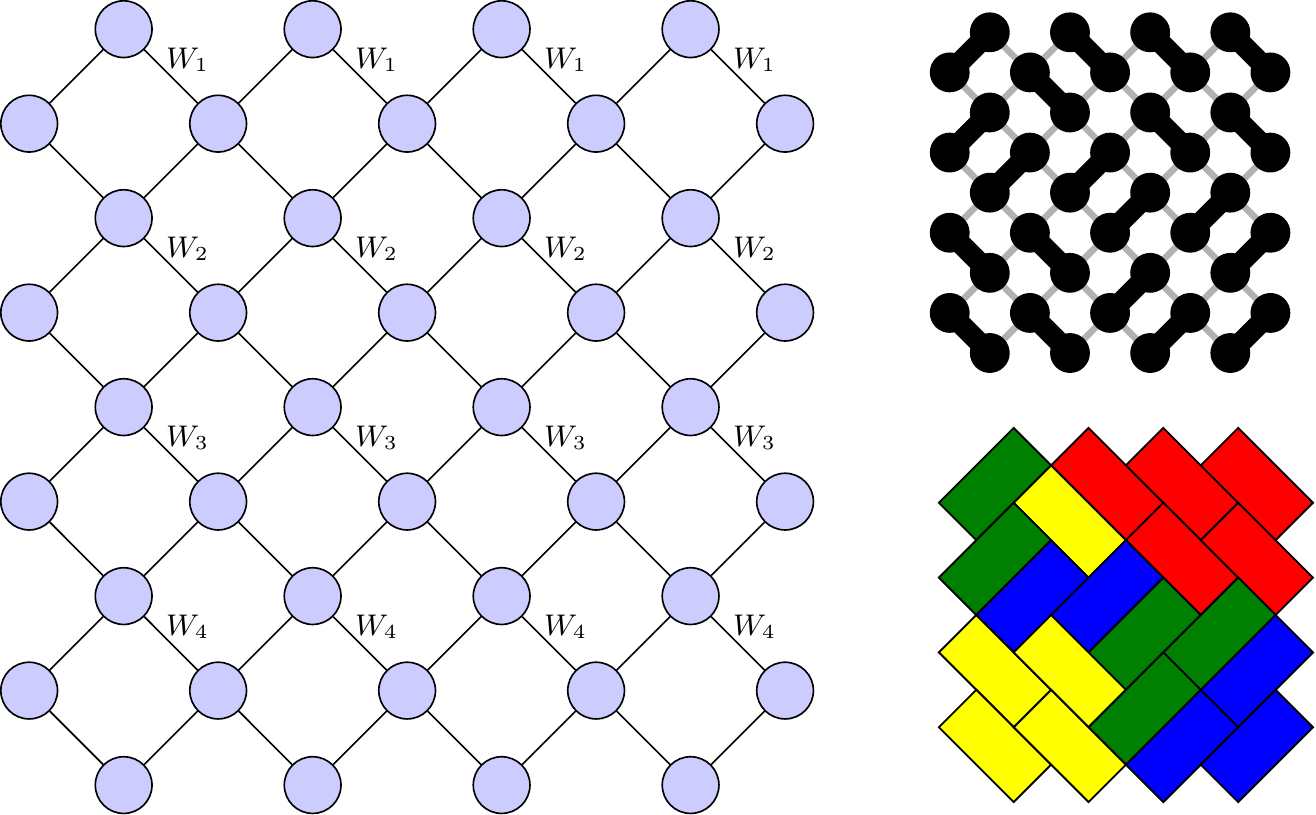
Diagonally Layered Disorder
Model:
Sample i.i.d. parameters \(\boldsymbol\beta_1,\ldots,\boldsymbol\beta_M\in(0,1)\). The nontrivial edge weight in diagonal layer \(j\) is
\(\displaystyle W_j=\frac{\boldsymbol\beta_j}{1-\boldsymbol\beta_j}\)
Unlabeled edges have weight \(1\). The raw weights \(W_j\) may be heavy-tailed.
Probability measure:
\(\displaystyle \mathbf{P}(D) = \frac{1}{Z} \prod_{e \in D} \operatorname{weight}(e)\)
Two regimes as \(M \to \infty\): [Bufetov–P.–Zografos 2025]
- Critical vanishing variance:
\(M\operatorname{Var}(\boldsymbol\beta_j)\to\sigma^2\), \(\boldsymbol\beta_j\to\beta\).
Same limit shape as deterministic \(W=\beta/(1-\beta)\). Global/moment covariance: GFF + Brownian term. - Fixed law of \(\boldsymbol\beta_j\), independent of \(M\).
New limit shape from \(\mathcal B\). Global moments scale \(\sqrt{M}\), with Brownian-in-level covariance.
Sampling...
Schur Generating Functions for Random Environment
Schur generating function
[Gorin–Panova 2012], [Bufetov–Gorin 2013]:
\(\displaystyle S_{\rho}(u_1,\ldots,u_N) = \sum_{\lambda} \rho(\lambda) \frac{s_\lambda(u_1,\ldots,u_N)}{s_\lambda(1^N)}\)
where \(\rho\) is the distribution of a partition \(\lambda\), and \(u_j \in \mathbb{C}\)
For random environment
[Bufetov–P.–Zografos 2025]:
The annealed SGF has an explicit product form (\(M\) is the size of the Aztec diamond, \(N\) is the level):
\(\displaystyle
\begin{aligned}
S_{\rho_N}(x_1,\ldots,x_N)
&= \operatorname{\mathbf E}_{\boldsymbol{\mathcal B}_M}
\prod_{j=N+1}^{M}\prod_{i=1}^{N}
(1-\boldsymbol\beta_j+x_i\boldsymbol\beta_j) \\
&=\left(\operatorname{\mathbf E}_{\boldsymbol{\mathcal B}_M}
\prod_{i=1}^{N}(1-\boldsymbol\beta+x_i\boldsymbol\beta)
\right)^{M-N}.
\end{aligned}
\)
where \(\boldsymbol\beta,\boldsymbol\beta_j\sim\boldsymbol{\mathcal B}_M\) are independent, and the raw edge weight is \(W=\boldsymbol\beta/(1-\boldsymbol\beta)\). No moment assumptions on \(W\): it can be heavy-tailed.
Asymptotics of the \(N\)-th root of the SGF as \(N\to\infty\) yield LLN and CLT for
the height function of the domino tilings.
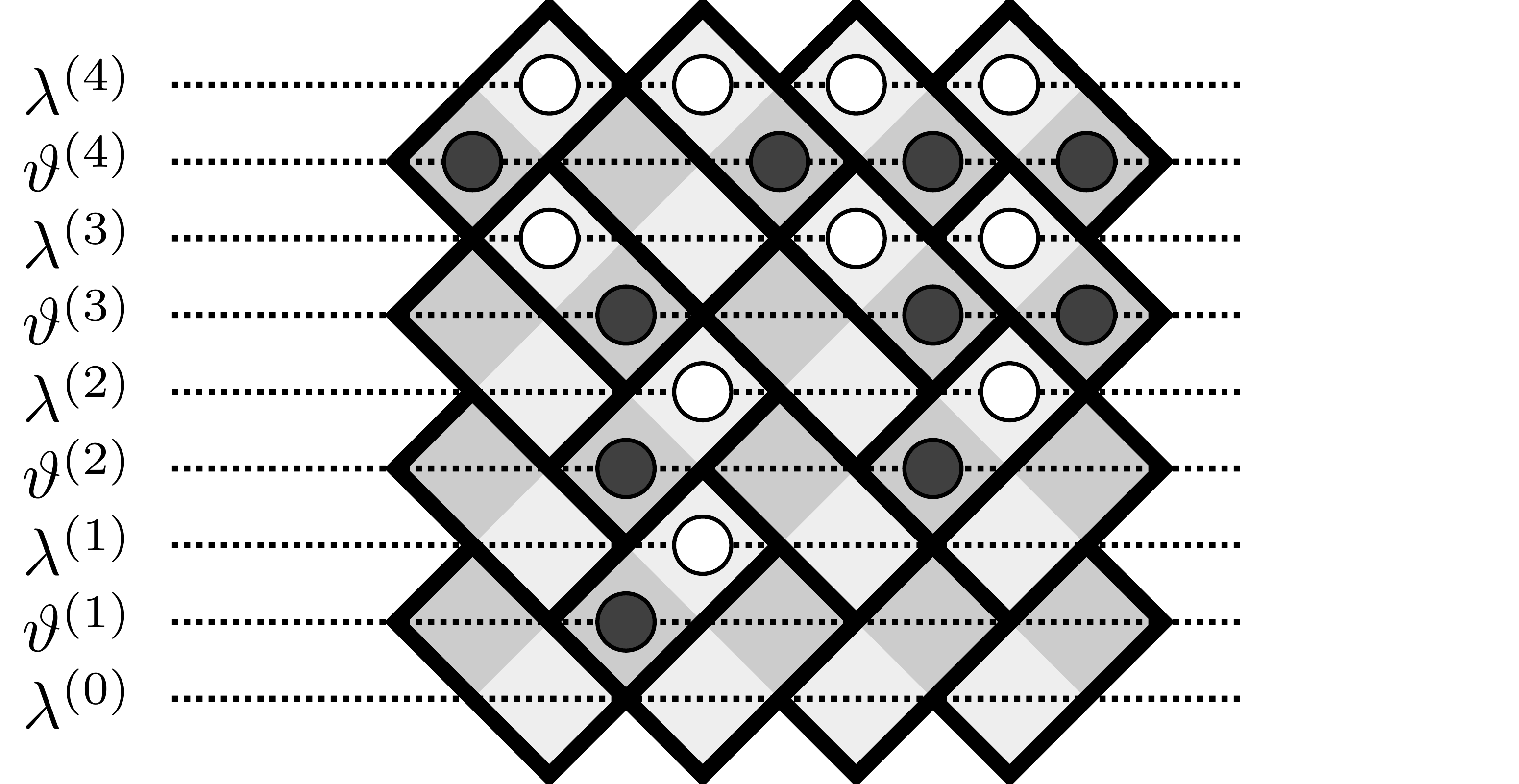
Limit Shapes Under Random Weights
Limit shape equation:
\((\alpha, y) \in [0,1]^2\) are coordinates in the Aztec diamond. Solve for \(z\) in the upper half-plane:
\(\displaystyle \frac{z}{z-1} + (\alpha^{-1}-1) z \, \mathbf{E}_{\mathcal B}\frac{W}{1+W z} = \alpha^{-1} y\)
(recall \(W=\boldsymbol\beta/(1-\boldsymbol\beta)\))
Limiting density:
\(\displaystyle (\alpha,y)\mapsto \frac{1}{\pi}\,\mathrm{Arg}\bigl(z(\alpha,y)\bigr)\)
Arctic curve
is the locus of double roots in \(z\), and we take real \(z\) as the parametrization of the frozen boundary.

Bernoulli
\(\tfrac12\) and \(5\)
Uniform
\(W_i \sim [0,2]\)
\(W_i \sim [0,2]\)
Sampling...
Diagonal Disorder
Annealed: Brownian motion
[Bufetov–P.–Zografos 2025]
pre-sampled
Quenched: GFF
[Berestycki–Laslier–Ray 2016], [Zografos 2025]
pre-sampled
Diagonal disorder, \(W_i \sim \mathrm{Uniform}[0,2]\), \(N=1000\)
Straight-Layered Disorder
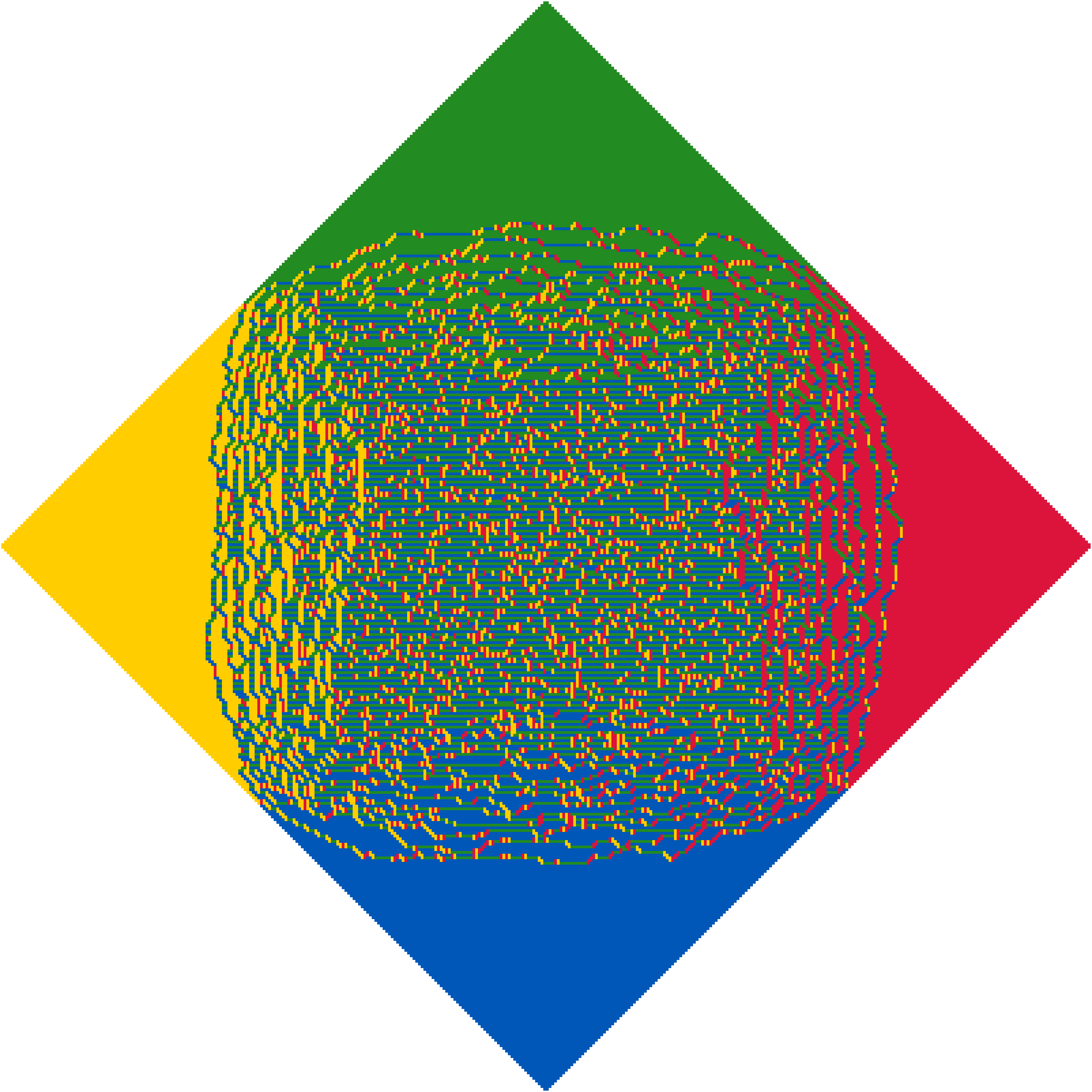
Straight-layered disorder:
i.i.d. weights along horizontal layers — a 45° rotation from the diagonal case.
\(W_i=0.3\) or \(5\) with prob \(\tfrac{1}{2}\).
[Moulard–Toninelli 2025, arXiv:2507.11964, on torus]: studied singularities of the free energy, showed correlations decay as \(e^{-\sqrt{\text{distance}}}\) instead of polynomially.
Strictly periodic
pre-sampled
Gauge equivalent to 2×2 periodic model
[Chhita–Johansson 2014]
Random layered
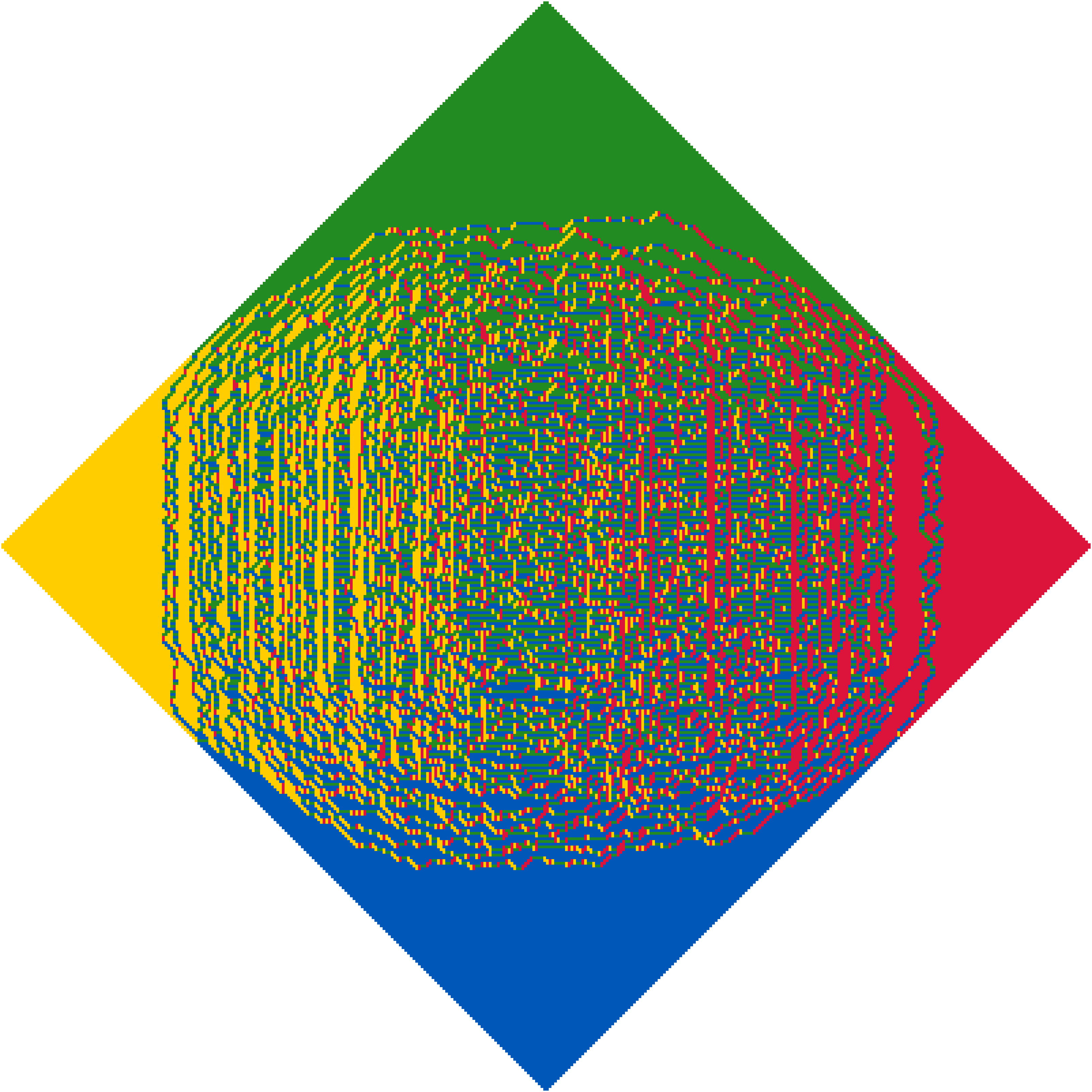
pre-sampled
Annealed
pre-sampled
Quenched
[Moulard–Toninelli 2025, on torus]
pre-sampled
Quenched fluctuations could be hyperrough: \(\mathrm{Var}(h) \sim (\log N)^2\)
[Perret–Ristivojevic–Le Doussal–Schehr–Wiese 2012, physics predictions]
IID Gamma-Distributed Weights
Model:
[Duits–Van Peski 2025, arXiv:2512.03033]
\(\alpha\) edges \(\sim \Gamma(\alpha, 1)\), \(\beta\) edges \(\sim \Gamma(\beta, 1)\). Gamma is the unique distribution preserved by the shuffling algorithm. Turning point fluctuations scale as \(n^{2/3}\) (vs \(n^{1/2}\) for deterministic weights). Connection to integrable polymers (log-Gamma, strict-weak).
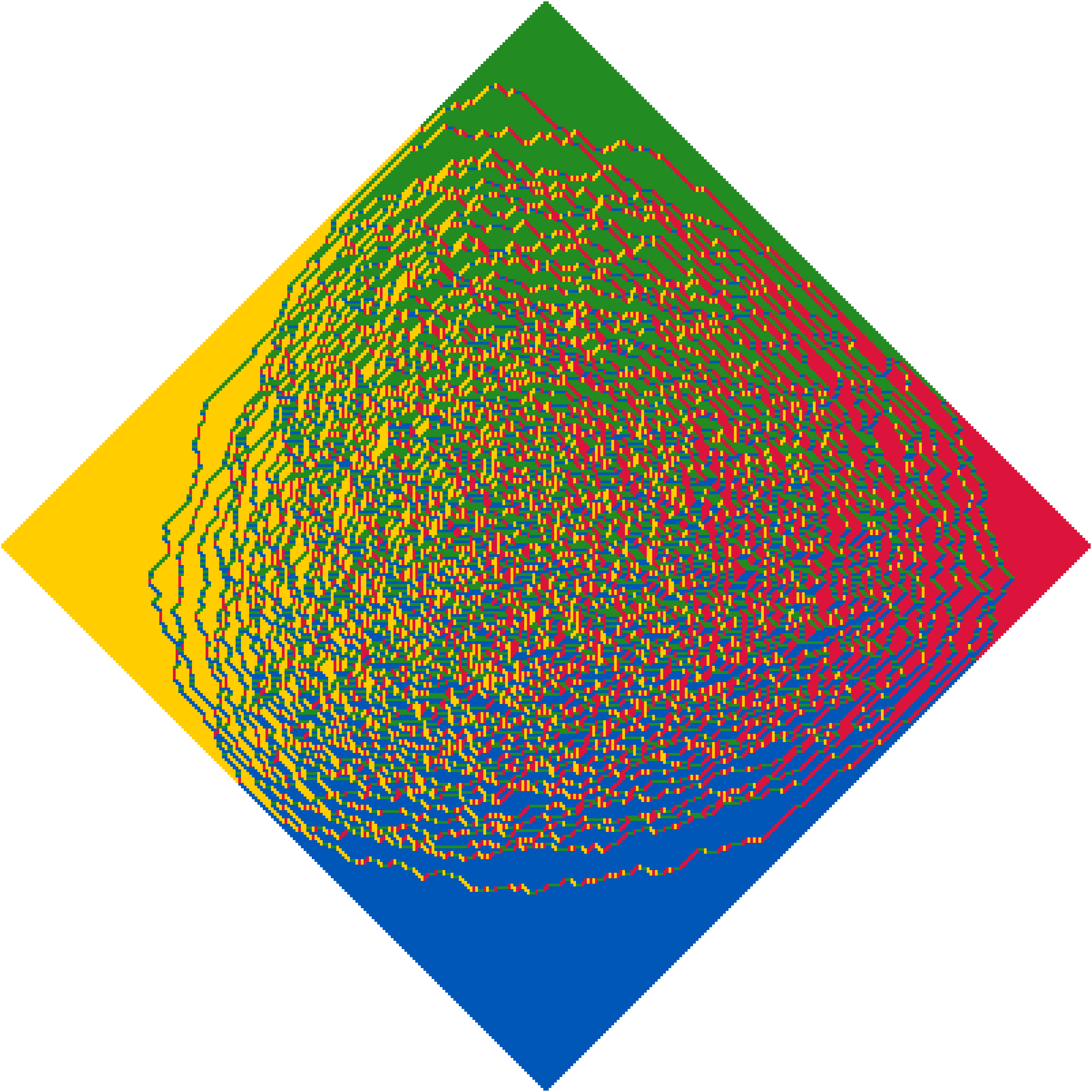
pre-sampled
\(\alpha = 0.2, \beta = 0.25\)
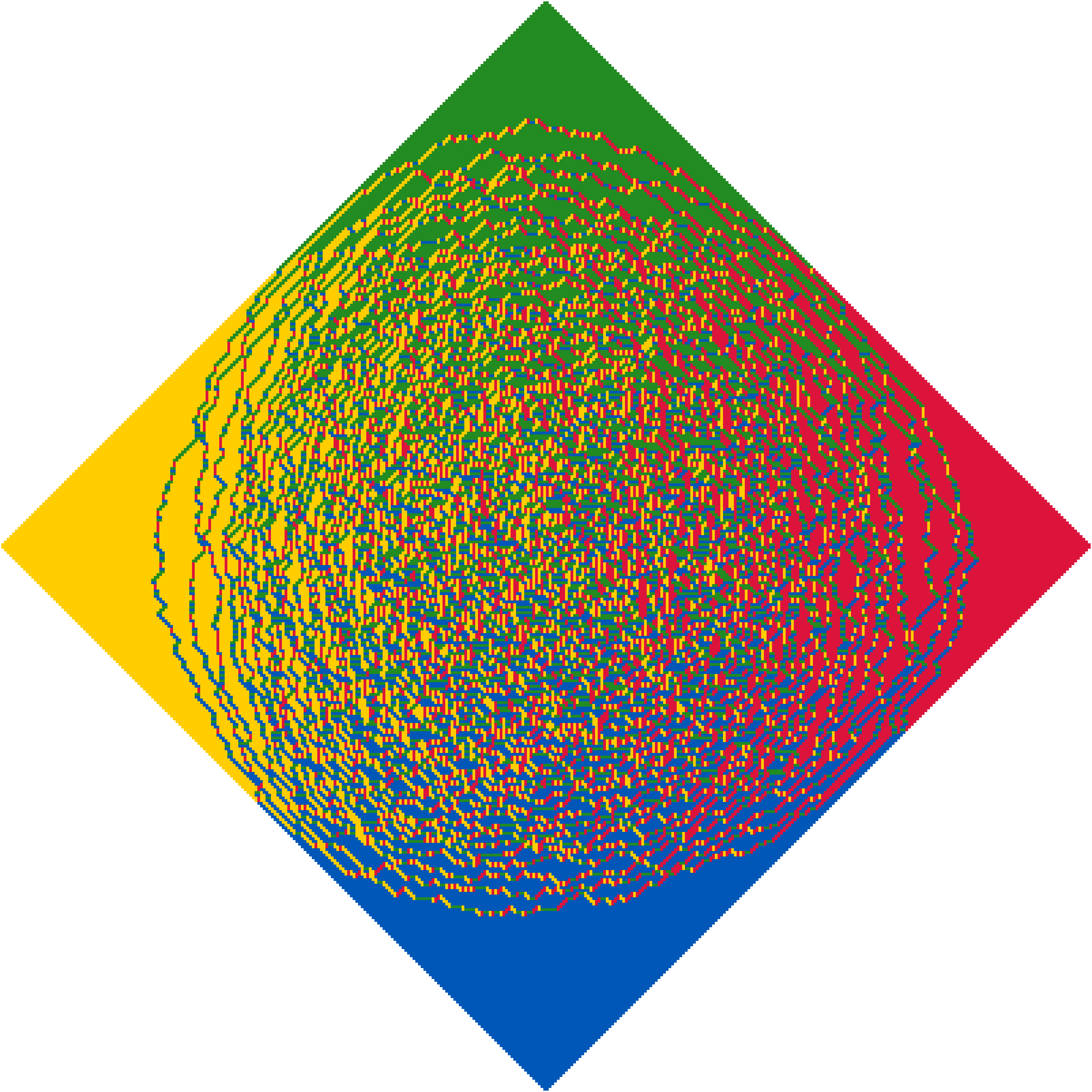
pre-sampled
\(\alpha = 1.0, \beta = 1.0\)
Annealed
pre-sampled
Quenched
pre-sampled
Summary
- Universality is well-developed, including local translation-invariant Gibbs measures, GFF global fluctuations (also Airy/KPZ at the edge, and several other universal regimes)
- The waterfall/barcode phenomenon [Knizel–P. 2025] describes an instance of dimensional collapse in the local behavior. So far, isolated in the q-Racah hexagon tilings, but should be present more broadly
- Random edge weights (disordered dimer models) is a new rich world with many new instances of potentially universal asymptotic behavior [Bufetov–P.–Zografos 2025], [Moulard–Toninelli 2025], [Zografos 2025], [Duits–Van Peski 2025]. Diagonally layered disorder is the most developed at this moment.
- Results presented today focus on breaking universality while preserving some exact solvability, so there is hope of rigorous analysis