Random Lozenge Waterfall: Dimensional Collapse of Gibbs Measures
2025/07/29
Alisa Knizel, Leonid PetrovarXiv:2507.22011 [math.PR] (opens in new tab)
Visualization
We investigate the asymptotic behavior of the $q$-Racah probability measure on lozenge tilings of a hexagon whose side lengths scale linearly with a parameter $L\to\infty$, while the parameters $q\in(0,1)$ and $\kappa\in \mathbf{i}\mathbb{R}$ remain fixed. This regime differs fundamentally from the traditional case $q\sim e^{-c/L}\to1$, in which random tilings are locally governed by two-dimensional translation-invariant ergodic Gibbs measures. In the fixed-$q$ regime we uncover a new macroscopic phase, the waterfall (previously only observed experimentally), where the two-dimensional Gibbs structure collapses into a one-dimensional random stepped interface that we call a barcode.
We prove a law of large numbers and exponential concentration, showing that the random tilings converge to a deterministic waterfall profile. We further conjecture an explicit correlation kernel of the one-dimensional barcode process arising in the limit. Remarkably, the limit is invariant under shifts by $2\mathbb{Z}$ but not by $\mathbb{Z}$, exhibiting an emergent period-two structure absent from the original weights. Our conjectures are supported by extensive numerical evidence and perfect sampling simulations. The kernel is built from a family of functions orthogonal in both spaces $\ell^{2}(\mathbb{Z})$ and $\ell^{2}(\mathbb{Z}+\frac12)$, that may be of independent interest.
Our proofs adapt the spectral projection method of Borodin–Gorin–Rains (2009) to the regime with fixed $q$. The resulting asymptotic analysis is substantially more involved, and leads to non-self-adjoint operators. We overcome these challenges in the exponential concentration result by a separate argument based on sharp bounds for the ratios of probabilities under the $q$-Racah orthogonal polynomial ensemble.
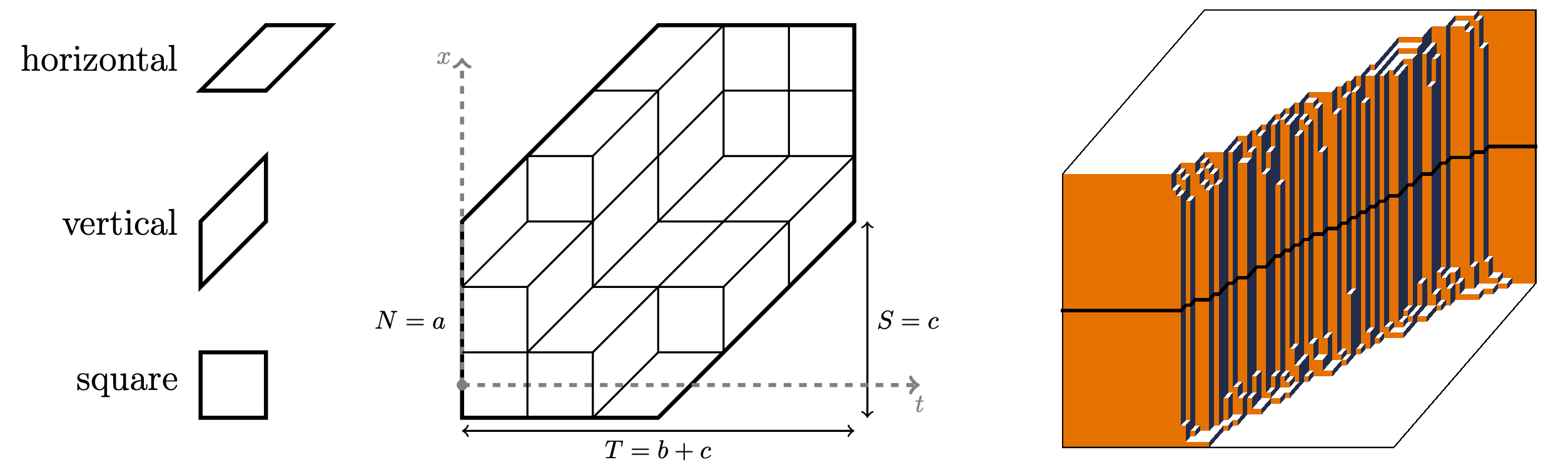
Left: the three types of lozenges. Center: an example of a lozenge tiling of a hexagon whose side lengths are all equal to 3. Right: a perfect sample of the q-Racah random tiling with N=50, T=100, S=30, q=0.7, and κ=3i. The cross-section of the 3D surface across the middle represents the barcode process.