q-randomized Robinson-Schensted-Knuth correspondences and random polymers
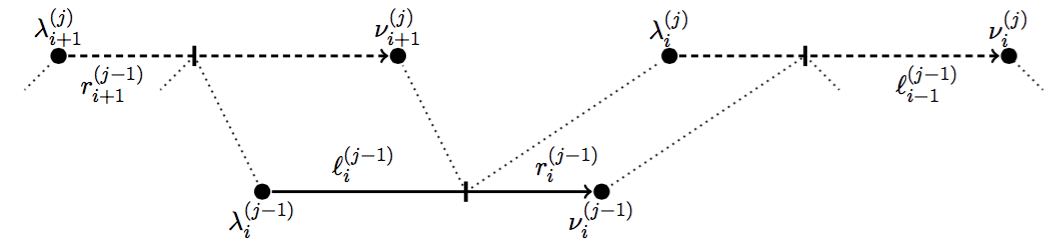
We introduce and study $q$-randomized Robinson-Schensted-Knuth (RSK) correspondences which interpolate between the classical ($q=0$) and geometric ($q\to 1$) RSK correspondences (the latter ones are sometimes also called tropical).
Simulations of stochastic higher spin vertex model
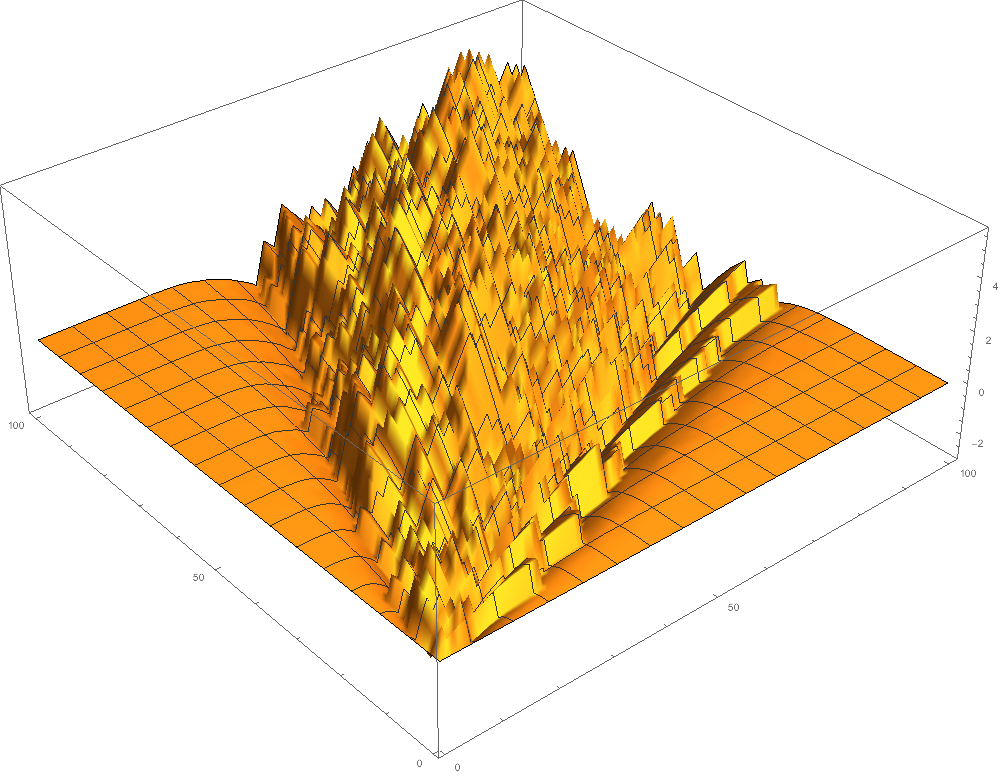
The stochastic higher spin vertex model introduced in my paper with Ivan Corwin ([arXiv:1502.07374 [math.PR]][ivan6v]) generalizes the stochastic six vertex model considered by Borodin, Corwin, and Gorin, arXiv:1407.6729 [math.PR]. Here are some simulations related to this model.
Dear colleagues:
Feel free to use these pictures to illustrate your research in talks and papers, with attribution (CC BY-SA 4.0 (opens in new tab)). Some of the images are available in very high resolution upon request.
Stochastic higher spin vertex models on the line
We introduce a four-parameter family of interacting particle systems on the line which can be diagonalized explicitly via a complete set of Bethe ansatz eigenfunctions, and which enjoy certain Markov dualities.

Implementation of Glauber dynamics simulation of random lozenge tilings
I’ve implemented the Glauber dynamics to (approximately) sample uniformly random lozenge tilings of polygons of Gelfand-Tsetlin type. These polygons are called sawtooth domains by J. Novak. This paper by B. Laslier and F.L. Toninelli establishes rate of convergence of the Glauber dynamics to the uniformly random lozenge tiling.
MATH 5110 • Introduction to Stochastic Processes
Spectral theory for interacting particle systems
This talk describes results on spectral theory for q-Hahn zero-range process, ASEP, six-vertex model, and q-TASEP. Based on [14] and [17].