Spectral theory for interacting particle systems solvable by coordinate Bethe ansatz
We develop spectral theory for the $q$-Hahn stochastic particle system introduced recently by Povolotsky. That is, we establish a Plancherel type isomorphism result which implies completeness and biorthogonality statements for the Bethe ansatz eigenfunctions of the system.
Facts about Markov chains
I have collected a number of facts about Markov chains that were discussed in lectures 5-9 in the graduate probability course in Spring 2014.
Law of Large Numbers for Infinite Random Matrices over a Finite Field
Asymptotic representation theory of general linear groups $GL(n,q)$ over a finite field leads to studying probability measures $\rho$ on the group $U$ of all infinite uni-uppertriangular matrices over $F_q$, with the condition that $\rho$ is invariant under conjugations by arbitrary infinite matrices.
What time of the day should I submit a preprint to arXiv?
A colleague addressed a question to me and others, and after discussing how arXiv orders submitted preprints we’ve concluded that the rules seem to be like this.
Second quantization
I “grew up” in mathematical sense learning about Fock spaces and some nice things one can do with them. There always was a mysterious physical term “second quantization” attached to the subject (wikipedia). Recently I was reading Felix Berezin’s lecture notes from 1966-67; they are called “Lectures on Statistical Physics”, in English: translated from the Russian and edited by Dimitry Leites), in Russian: MCCME 2008. The full English text can be readily found.
Chapter 25 of these lecture notes contains a clear and historic description of second quantization, in a unified way for Bosons and Fermions. Let me briefly record how this is done.
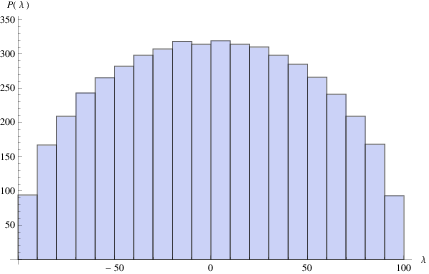
How Dyson obtained his Brownian motion in 1962
Looking for an answer to a colleague’s question, I was reading a 1962 seminal paper by Freeman J. Dyson: “A Brownian-Motion Model for the Eigenvalues of a Random Matrix” published in J. Math. Phys. 3, 1191 (1962).
The question was, how the original proof of Dyson’s result about his Brownian motion of eigenvalues of random matrices was carried out? I will try to reproduce Dyson’s arguments. His physics paper was missing some of the computations; I will also not go to all technical details, but rather work out finite cases at an elementary level.
Arguments similar to the original Dyson’s ones also appear (in a more advanced form) in this post by T. Tao. He deals with the proof of Theorem 2 (Dyson’s Brownian motion), but does not mention the proof Theorem 1 (density of eigenvalues) in that post.
MATH 7241 • Probability 1 (graduate)
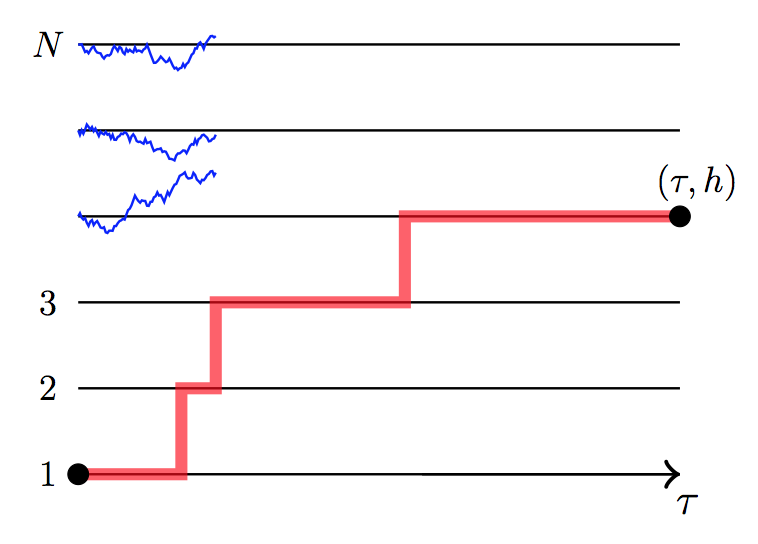
Integrable Probability: Random Polymers, Random Tilings, and Interacting Particle Systems
One of the versions of my “job talk” in Fall 2013 describing many facets of integrable probability. It is supposed to be accessible. The talk is based on [15] and on the previous two talks. More details can also be found in arXiv:1106.1596 [math.PR] by Corwin and arXiv:1212.3351 [math.PR] by Borodin and Gorin.