MATH 1342 • Calculus II for Sci&Eng, Honors
The Boundary of the Gelfand-Tsetlin Graph: New Proof of Borodin-Olshanski's Formula, and its q-analogue
In the recent paper [arXiv:1109.1412], Borodin and Olshanski have presented a novel proof of the celebrated Edrei-Voiculescu theorem which describes the boundary of the Gelfand-Tsetlin graph as a region in an infinite-dimensional coordinate space.
Asymptotics of uniformly random lozenge tilings of polygons. Gaussian free field
We study large-scale height fluctuations of random stepped surfaces corresponding to uniformly random lozenge tilings of polygons on the triangular lattice.
Random 3D surfaces and their asymptotic behavior
The talk describes the results of [9], [10], and [11] on asymptotic behavior of random lozenge tilings via determinantal structure and double contour integral formulas for the correlation kernel.
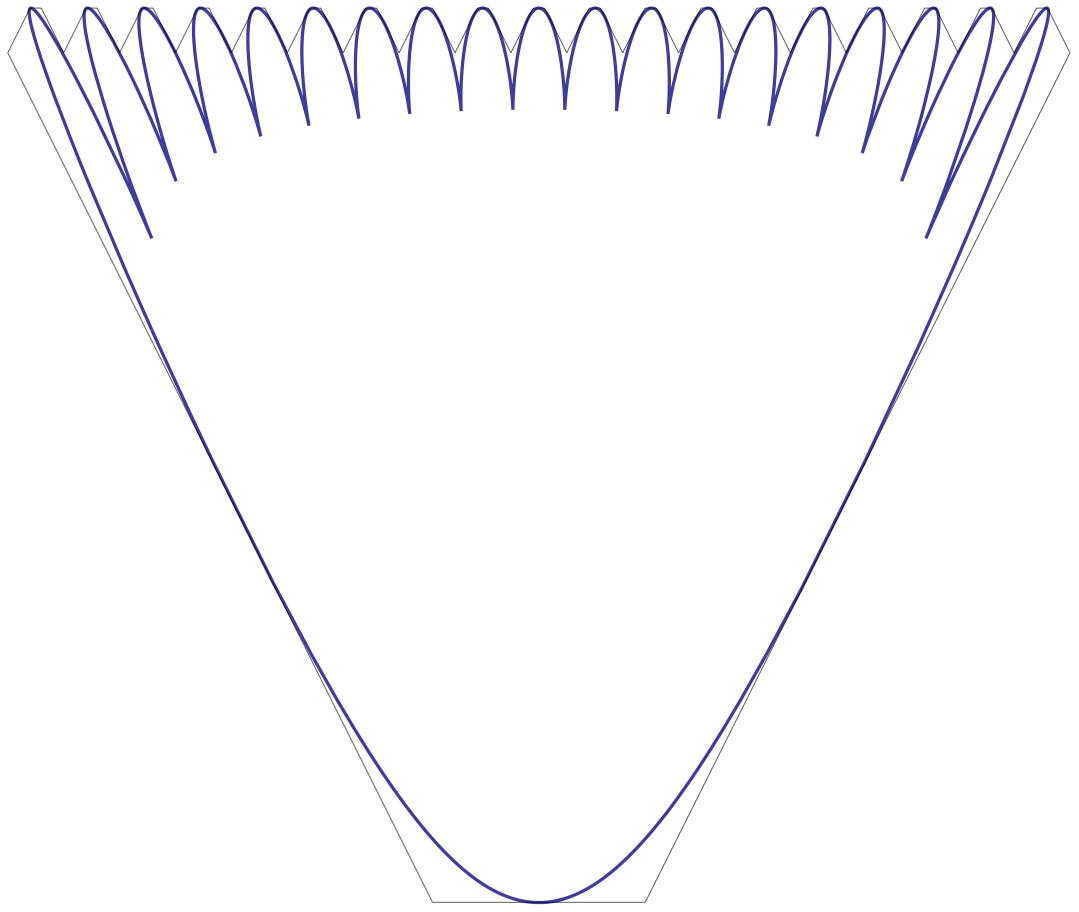
Asymptotics of Random Lozenge Tilings via Gelfand-Tsetlin Schemes
A Gelfand-Tsetlin scheme of depth $N$ is a triangular array with m integers at level $m$, $m=1,\ldots,N$, subject to certain interlacing constraints. We study the ensemble of uniformly random Gelfand-Tsetlin schemes with arbitrary fixed $N$-th row. We obtain an explicit double contour integral expression for the determinantal correlation kernel of this ensemble (and also of its q-deformation).
MATH 3081 • Probability and Statistics (2 sections)
Asymptotic representation theory lectures by G. Olshanski (in Russian)
- Fall 2009
- Characters of the infinite-dimensional unitary group
- Shifted symmetric functions
- Total nonnegativity
- Factor representations of infinite-dimensional unitary group
- Point processes related to the unitary groups
- Spring 2010
- Schur-Weyl duality
- Robinson-Schensted correspondence
- Plancherel measures, difference operators
- Orbital HCIZ integrals
- Classification of ergodic central measures on infinite-dimensional Hermitian matrices
sl(2) Operators and Markov Processes on Branching Graphs
We present a unified approach to various examples of Markov dynamics on partitions studied by Borodin, Olshanski, Fulman, and the author. Our technique generalizes the Kerov’s operators first appeared in [Okounkov, arXiv:math/0002135], and also stems from the study of duality of graded graphs in [Fomin, 1994].