How to enable SSL for a homepage hosted on S3
As Google Chrome will mark all HTTP websites unsafe later this year, it is time to figure out how to enable SSL on my websites. I currently have 3 websites under active management:
- this homepage
lpetrov.cc - the FRG website
- the UVA Math department website
All three of them are hosted through AWS, but the homepage is by far the easiest as it only involves S3 and no EC2 instances. So at first I decided to turn on SSL at the homepage, which I succeeded with.
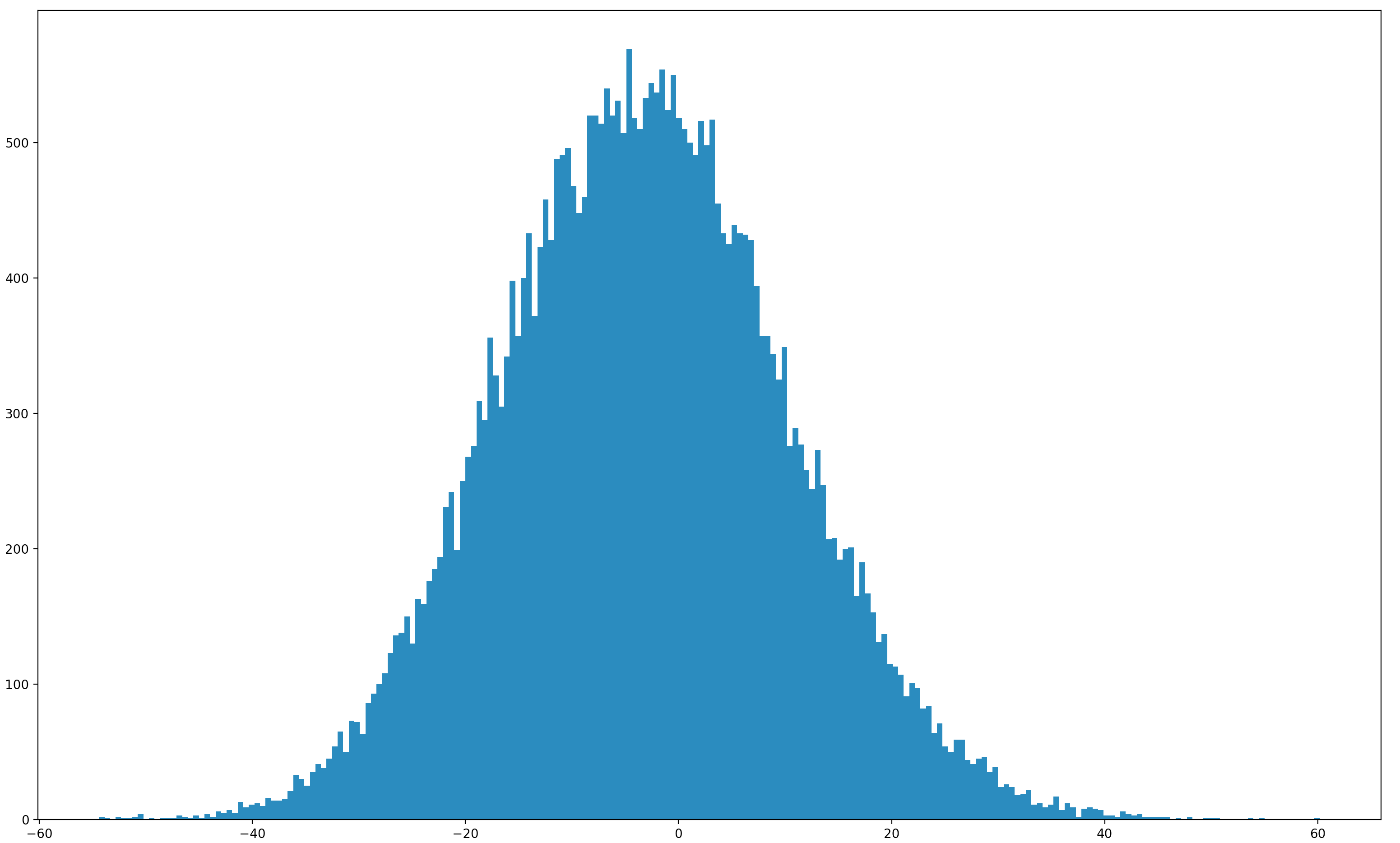
Quenched Central Limit Theorem in a Corner Growth Setting
We consider point-to-point directed paths in a random environment on the two-dimensional integer lattice. For a general independent environment under mild assumptions we show that the quenched energy of a typical path satisfies a central limit theorem as the mesh of the lattice goes to zero. Our proofs rely on concentration of measure techniques and some combinatorial bounds on families of paths.
Nonequilibrium particle systems in inhomogeneous space
This talk describes results on continuous space TASEP in inhomogeneous space, based on papers with Borodin and with with Knizel and Saenz, and on some work in progress.

A sign in Boston Logan airport commemorating deformed Bosons
This sign works equally well for both $q$-Bosons and $t$-Bosons, so the choice of parameter is up to the tourist.
References
-
T. Sasamoto and M. Wadati, Exact results for one-dimensional totally asymmetric diffusion models, J. Phys. A 31 (1998), 6057–6071
-
A. Borodin, I. Corwin, L. Petrov, T. Sasamoto, Spectral theory for the q- Boson particle system, Compositio Mathematica 151 (2015), no. 1, 1–67, arXiv:1308.3475 [math-ph]
[quick link] A sign in Boston Logan

Installing specific versions of biblatex and texlive for arxiv
(An update on the previous post)
So, I had a problem - my TeX distribution is new and updated, but I need to submit a paper
to the arXiv, and arXiv has a different version of TeX distribution (currently 2016).
The main problem is biblatex, which creates an incompatible version of the bibliography .bbl file.
For this, I need an appropriate version of the biblatex package.

Simulations of inhomogeneous multilayer pushTASEP
I’ve done some simulations of a multilayer version of the pushTASEP in inhomogeneous space, in my new simulations gallery.
Technical details and more pictures are here.
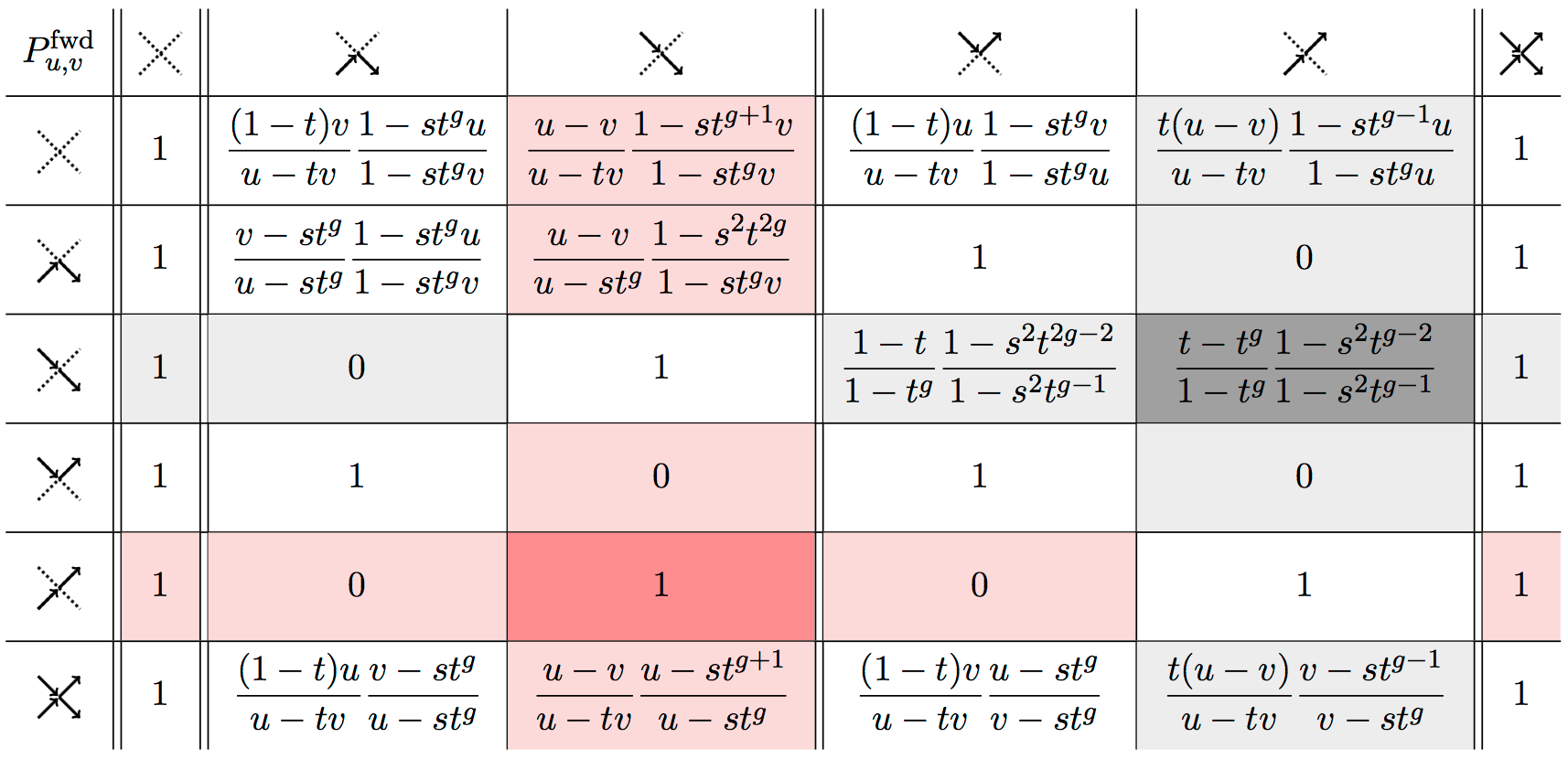
Yang-Baxter field for spin Hall-Littlewood symmetric functions
Employing bijectivisation of summation identities, we introduce local stochastic moves based on the Yang-Baxter equation for . Combining these moves leads to a new object which we call the spin Hall-Littlewood Yang-Baxter field - a probability distribution on two-dimensional arrays of particle configurations on the discrete line. We identify joint distributions along down-right paths in the Yang-Baxter field with spin Hall-Littlewood processes, a generalization of Schur processes. We consider various degenerations of the Yang-Baxter field leading to new dynamic versions of the stochastic six vertex model and of the Asymmetric Simple Exclusion Process.